The Fractal Geometry of Wire Harness Design: Lessons from Ants, Rivers, and Veins
I’ve spent over a decade in the foreign trade and manufacturing industry, mostly dealing with the gritty reality of production floors, component sourcing, and technical reviews. But lately, I’ve found myself thinking about something that goes far beyond part numbers and Excel spreadsheets.
It’s about patterns—and how a few childhood observations completely changed the way I look at modern industrial wire harness design.
The Boy, the Ants, and the Muddy Streams
Some of my earliest memories have nothing to do with machinery. When I was a kid, I used to spend hours crouched in the dirt after a heavy rainstorm, completely fascinated by things most people walked right past.
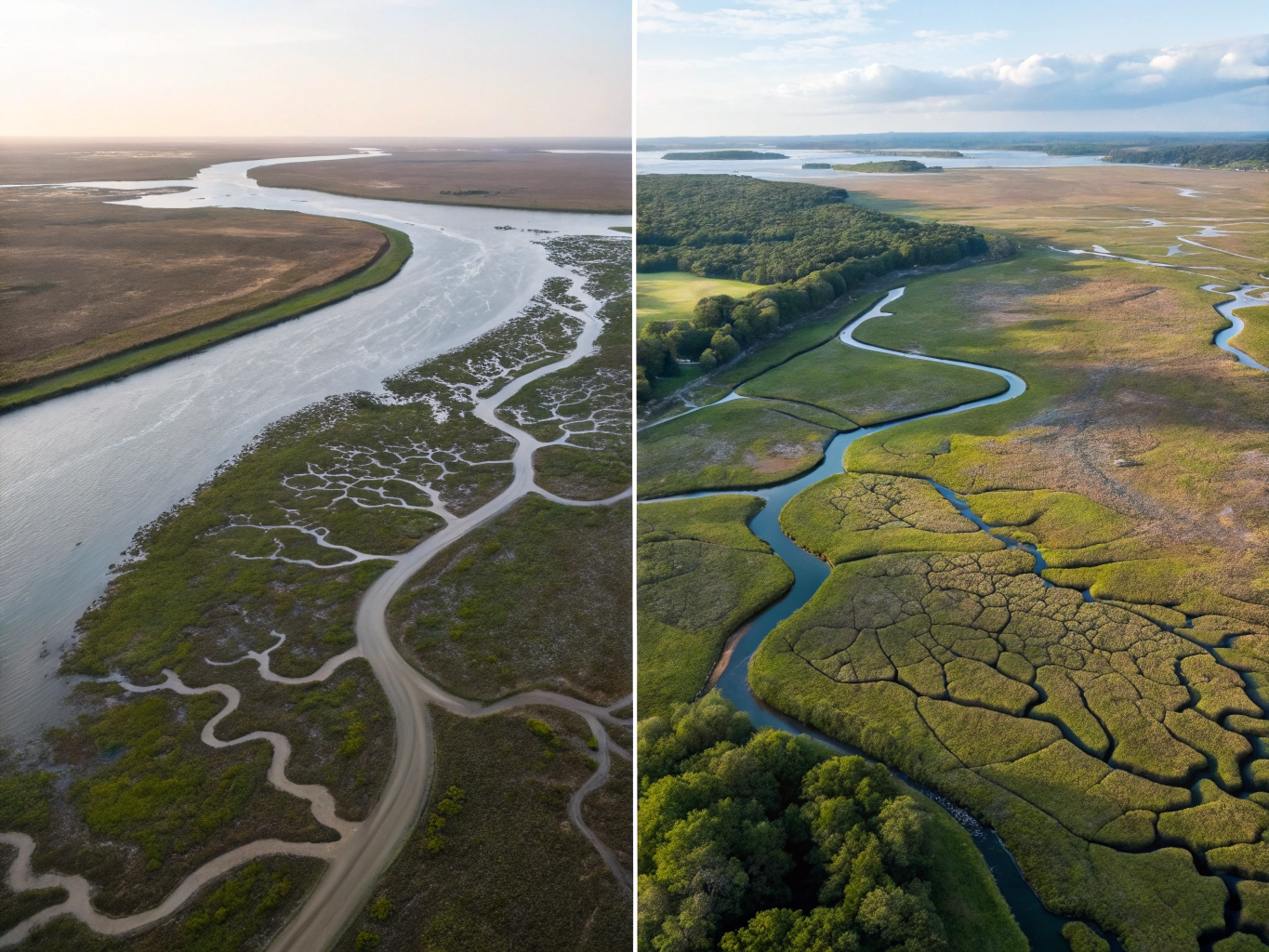
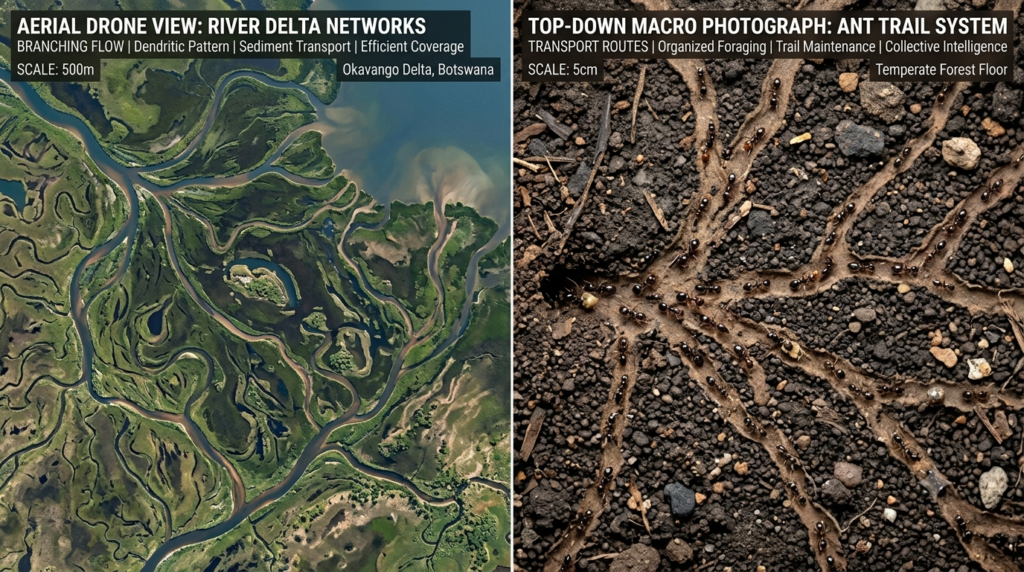
I’d watch leafcutter ants carve highly organized, invisible highways through the soil. They moved with a strange, collective efficiency, never bottlenecking. Right next to them, I’d watch muddy rainwater split into tiny rivulets, which would then merge perfectly into larger streams to drain the yard.
Years later, during routine doctor visits, I remember staring at the blue network of veins on the back of my hand—large tracks splitting into smaller branches, eventually dissolving into a microscopic mesh of capillaries.
At the time, I didn’t have the mathematical vocabulary to describe it. I just had questions: Why do ants, water, and blood vessels all build the exact same branching architecture? What universal problem are they trying to solve?
The College Lightbulb: Mandelbrot and Murray’s Law
The dots finally connected during a university course on ecology and micro-ecosystems. We were studying how nutrient networks expand under spatial constraints—how tree roots optimize absorption, or how fungal mycelium finds the absolute shortest path to resources.
That was my introduction to Fractal Geometry, pioneered by Benoît Mandelbrot. Nature rarely designs in straight lines or rigid 90-degree angles because Euclidean geometry is incredibly inefficient at handling dynamic, space-filling volumes. Instead, nature uses self-similar structures that repeat at smaller and smaller scales. Why? Because it maximizes coverage and structural reliability while using the absolute minimum amount of material.
In fluid dynamics, this is called Murray’s Law (1926). It states that when a main transport trunk branches into smaller ones, the cube of the radius of the parent vessel equals the sum of the cubes of the radii of the daughter vessels.
In plain English, the law looks like this:
r₀³ = r₁³ + r₂³ + … + rₙ³
(Where r₀ is the radius of the main trunk, and r₁, r₂, etc., are the radii of the smaller branches).
This cubic relationship ensures that the volumetric flow rate stays perfectly optimized, minimizing the energy required to pump fluid against resistance.
When I later got into custom wire harness design, it hit me: the physics change from fluid dynamics to Ohm’s Law and thermal dissipation, but the optimization problem is identical. Instead of fluid resistance, our constraints are voltage drops, electromagnetic interference (EMI), and heat buildup. To prevent catastrophic bottlenecks, the cross-sectional area of our conductor trunks has to scale predictably relative to their terminal branches. It’s the exact same scaling framework.
The Reality Check on the Factory Floor
Early in my career, while reviewing a complex multi-axis machine wiring layout on a 3D CAD terminal, I had a massive wave of déjà vu.
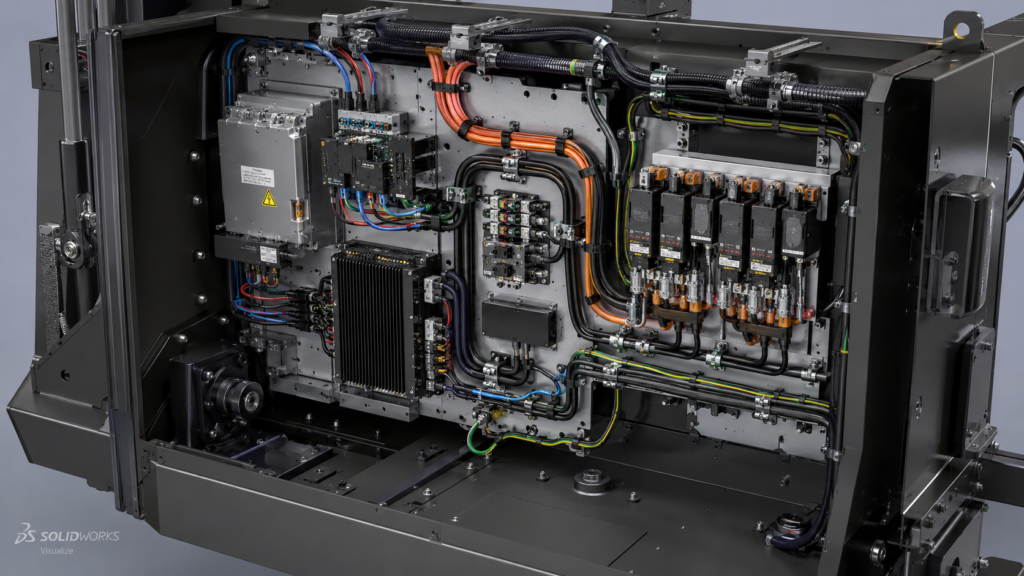
The master power trunk looked exactly like a major river basin. The branch sub-harnesses looked like tributaries. The shielded sensor lines were the capillaries, extending to the furthest extremities of the machine to gather real-time data.
But here is where the analogy broke down: nature is flawless, and human engineering often isn’t.
Traditionally, industrial wire harness design has been incredibly siloed. You know the drill:
The mechanical team designs a rigid steel frame.
The electrical team draws up a separate 2D schematic in a vacuum.
The physical wiring is treated as an afterthought—forced to bend, pinch, and squeeze into whatever residual spaces are left over.
This bad habit completely violates the physics of optimal flow. To fix it, we had to stop acting like simple parts manufacturers and start thinking like systems architects. We had to embrace Model-Based Systems Engineering (MBSE), treating the wire harness not as a dumb bundle of copper and plastic, but as the master circulatory and nervous system of the machine.
Modern wire harness design relies on advanced 3D CAD modeling to optimize routing, reduce installation complexity, and ensure long-term reliability. Digital engineering enables manufacturers to validate mechanical fit, electrical performance, and assembly efficiency before production begins.
Nature vs. Hardware: The Optimization Matrix
The Engineering Challenge
Nature’s Answer
The Digital Equivalent
Trunk-to-Branch Ratios
Murray’s Law (Vessel Radii Scaling)
Automated cross-sectional and voltage drop calculation in platforms like Vector PREEvision.
Path Optimization
Ant Pheromone Trails (Stigmergy)
Generative Design routing algorithms.
Environmental Strain
Vascular Wall Thickening / Growth
Real-time mechanical stress, strain, and minimum bend-radius simulation in 3D CAD.
Failure Redundancy
Collateral Circulation / Capillary Loops
Dual-channel signal isolation, safety loops, and automated failure-mode routing.
Building an Artificial Evolutionary Environment
To actually apply these natural laws to heavy industrial applications, you can’t rely on manual drafting. It’s too complex. Today, my team uses software ecosystems like Siemens Capital and NX to build true Digital Twins.
Instead of a designer manually tracing a wire path through a tight enclosure, we feed the physical boundaries, environmental tolerances, signal weights, and mechanical keep-out zones directly into the generative engine. The Digital Thread connects everything—from the initial logic schematic to the automated formboard on our factory floor.
Through Generative Design, the software can run thousands of routing iterations using Ant Colony Optimization (ACO) algorithms. This is literal biomimicry: the math is derived from how real ants drop virtual pheromones to find the shortest path. The algorithm constantly tweaks the layout to cut down material weight and mitigate EMI, while strictly respecting mandatory bend radii.
By integrating architectures like Vector PREEvision, we finally got rid of error-prone, fragmented Excel spreadsheets. We have a single source of truth. If a signal pin changes at the sensor level, that modification ripples instantly through the entire digital thread, updating the schematic, the 3D space, and the manufacturing Bill of Materials (BOM) at the same time.
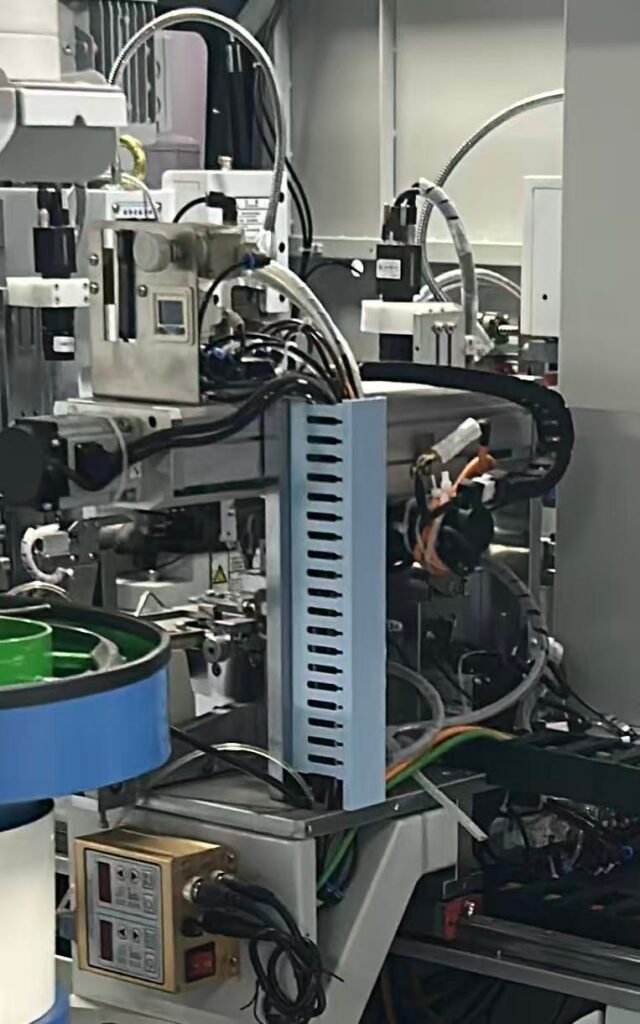
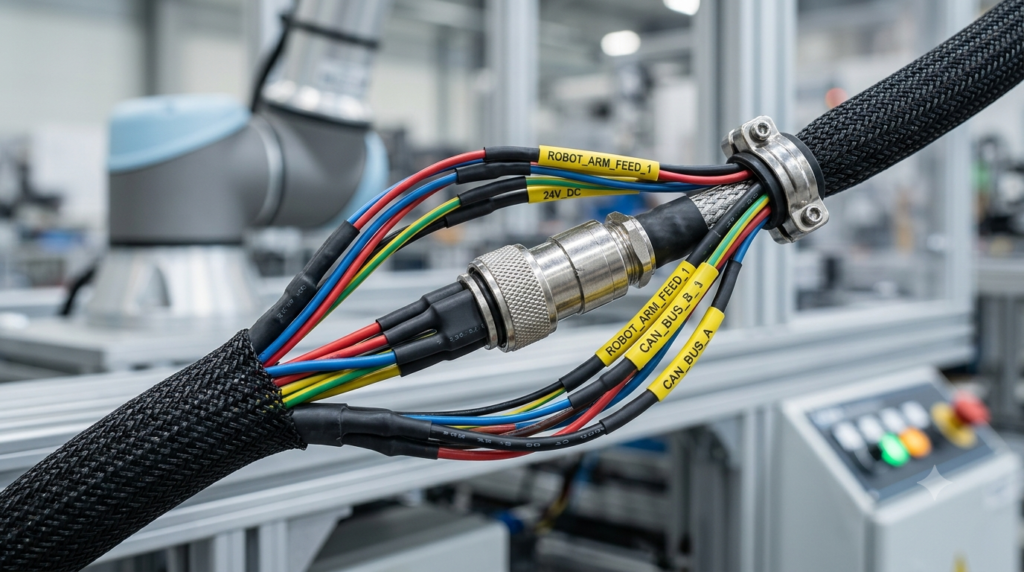
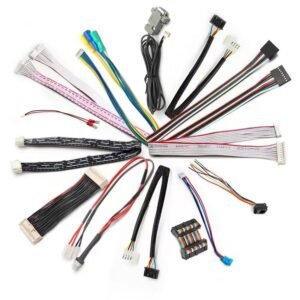
Every custom wire harness is built to meet the mechanical, electrical, and environmental demands of its application. Precision assembly, robust shielding, and high-quality connector integration ensure reliable performance in robotics, automation, medical equipment, and mission-critical industrial systems
Wiring the Brains of Industrial AI
In legacy automation, wire harnesses just connected dumb hardware blocks—a sensor to a PLC. But as we move into the era of Industrial AI and edge computing, everything is changing.
We are shifting away from rigid, centralized control toward decentralized autonomous systems, where cooperating AI agents and multi-axis robots need to talk to each other in real time. In this new landscape, the wire assembly becomes the physical infrastructure for machine intelligence.
Data is the new blood. AI agents are the organs. The connectivity solutions we build are the physical neural pathways keeping them synchronized.
In high-speed robotic wiring or smart factories, a millisecond of latency or a few micro-volts of signal attenuation isn’t just an annoyance—it’s a catastrophic failure of intelligent perception. If a robotic arm can’t stream its spatial telemetry instantly to its localization model because of poor shielding or unoptimized cable lengths, the whole system breaks down.
At my factory, WireAssyTech, our job has evolved far beyond crimping terminals or wrapping conduit tape. We are engineering the deterministic pipelines that allow smart factory connectivity to scale safely. We’re building physical networks that can handle the intense bandwidth demands of modern, multi-agent automated systems.
A high-contrast macro photograph of your finished custom cable assembly. Showcase clean branching points, robust heavy-duty shielding, neat corrugation/mesh wrap, and professional industrial connectors.
When I look at a complex connector block or a tangled wire loom on the floor today, I don’t just see hardware. I see echoes of river deltas and neural highways.
I don’t claim to have patented an ant-inspired routing algorithm or invented a new fractal wiring standard. But I do know that the engineers who look at biology and mathematics are the ones building the most resilient systems. The child who loved watching ant trails is the exact same engineer suggesting we rethink wiring architecture.
The next time you review a cable assembly layout or draft a robotic harness diagram, take a second to look for the patterns. Are you fighting against the space, or are you letting the design flow naturally?
I’d love to hear from other engineers, clients, and colleagues: How is your team handling complexity on the floor, and how are you balancing weight, cost, and reliability in your connectivity solutions?
AI Infrastructure Is Becoming a Physical Supply Chain Problem For the past three years, most discussions about artificial intelligence have focused on models, GPUs and