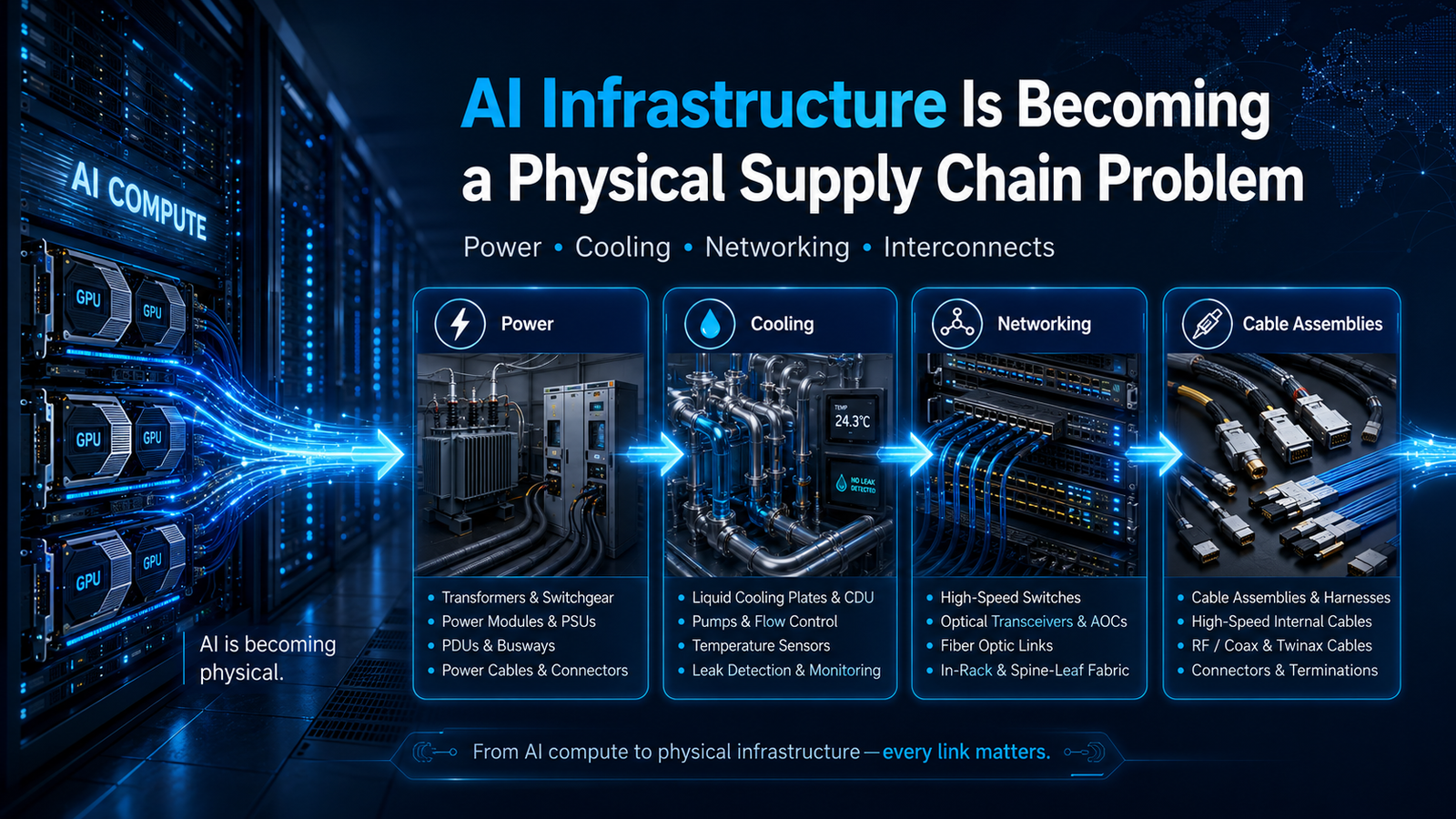
AI Infrastructure Is Becoming a Physical Supply Chain Problem
For the past three years, most discussions about artificial intelligence have focused on models, GPUs and software.
But the next phase of the AI buildout is increasingly constrained by something much more physical:
Power. Cooling. Networking. Connectors. Cables. Land. And manufacturing capacity.
That change matters for data-center operators, server manufacturers, equipment OEMs and the companies supplying the components behind them.
The important question is no longer simply:
How many GPUs will the AI industry need?
A better question is:
What physical infrastructure is required to power, cool and connect all of those GPUs?
That is where a new supply-chain opportunity is emerging.
AI Demand Is Moving Down the Infrastructure Stack
Every AI request ultimately produces a chain of physical demand.
More AI workloads require more computing.
More computing requires more GPUs and accelerators.
More GPUs require more electricity.
More electricity requires more power-distribution equipment.
Higher rack density requires more sophisticated cooling.
More accelerators also require higher-bandwidth connections between GPUs, switches, storage and servers.
The chain looks roughly like this:
AI workloads
↓
GPU / accelerator capacity
↓
Servers and racks
↓
Power distribution
↓
Cooling
↓
High-speed networking
↓
Cables, connectors, sensors and control systems
The further AI expands, the more important these physical layers become.
This is one reason the AI infrastructure market is beginning to look less like a pure software market and more like a massive industrial infrastructure cycle.
1. Electricity Is Becoming One of AI’s Most Important Constraints
One of the clearest signals is coming from the data-center market.
Reuters reported that European hyperscale data-center developers are increasingly moving new AI projects away from traditional hubs such as London and Frankfurt toward locations where electricity, land and grid connections are easier to secure.
According to JLL data cited by Reuters, planned European data centers coming online between 2026 and 2028 will be located an average of around 175 kilometers from major hubs, compared with only 46 kilometers for projects delivered between 2022 and 2025.
The determining factor is increasingly where sufficient power can be secured.
A similar trend is appearing in the United States.
The U.S. Energy Information Administration expects U.S. electricity consumption to reach new records in both 2026 and 2027, with AI-focused data centers among the major drivers of increasing commercial power demand.
This changes the AI hardware supply chain.
The bottleneck is moving from:
Can we buy enough GPUs?
toward:
Can we deliver enough power to the computing equipment?
That creates demand throughout the electrical infrastructure stack:
- transformers
- switchgear
- UPS systems
- PDUs
- busbars
- high-current connectors
- power cable assemblies
- monitoring systems
- control wiring
- battery energy-storage systems
For hardware suppliers, this is an important shift.
The AI infrastructure opportunity does not stop at the semiconductor.
It extends all the way to the cable that carries power into the rack.
2. Higher Rack Density Changes Power Cable Requirements
Traditional server infrastructure was designed around much lower power density than today’s GPU clusters.
As rack power increases, cable assemblies face a different engineering environment.
Current capacity becomes more important.
So do:
- conductor sizing
- connector temperature rise
- contact resistance
- voltage drop
- insulation rating
- routing space
- bend radius
- airflow obstruction
- mechanical retention
- thermal reliability
A cable assembly that works perfectly in a conventional industrial application may not automatically be appropriate for a high-density AI rack.
That is why power-distribution cables are becoming an engineering component rather than simply a commodity wire.
At WireAssyTech, for example, our Industrial AI and Automation manufacturing capabilities include high-current PDU cable assemblies for applications up to 600V / 250A, together with custom routing, termination and testing requirements for OEM equipment.
For server and data-center hardware companies, supplier qualification therefore increasingly needs to consider not only unit price but also:
electrical performance + thermal behavior + mechanical reliability + manufacturing repeatability.
3. Cooling Creates an Entire New Wiring Layer
Power is only half of the problem.
Almost every watt consumed by computing hardware eventually becomes heat.
As GPU density increases, traditional air cooling becomes increasingly difficult.
This is accelerating the deployment of technologies such as:
- direct-to-chip liquid cooling
- cold plates
- coolant distribution units
- pumps
- flow meters
- pressure sensors
- temperature sensors
- leak-detection systems
- valves
- monitoring controllers
Each of these systems creates additional electrical interconnections.
A liquid-cooling system may require surprisingly little computing power itself, but it can require a complex network of:
sensor cables + pump wiring + control harnesses + communication cables + leak-detection assemblies.
Reliability is critical.
A GPU server going offline because of a failed sensor connector or damaged control harness can cost dramatically more than the cable itself.
That is why AI thermal-management suppliers represent an interesting new customer category for custom wire-harness manufacturers.
WireAssyTech already supports liquid-cooling leak-detection sensor harnesses as part of its data-center and thermal-management wiring capabilities.
4. The Next Bottleneck Is Moving from Compute to Interconnect
AI clusters do not operate as isolated servers.
Thousands of processors must continuously exchange data.
As model sizes and distributed workloads increase, the performance of the network connecting those processors becomes increasingly important.
This is driving demand for:
- PCIe 5.0 / PCIe 6.0 interconnects
- MCIO cable assemblies
- high-speed copper
- high-speed networking
- optical modules
- silicon photonics
- RF and precision coaxial connections
There are already signs of supply pressure further upstream.
Soitec, for example, has been moving customers toward multi-year supply agreements as demand increases for silicon-photonics wafers used in AI data-center optical systems. Reuters reported that the company expects revenue from this segment to more than double during its current financial year.
The broader signal is important:
AI is creating demand not only for computing chips, but also for everything that moves data between them.
Inside servers and accelerator systems, this creates increasing requirements for compact, high-bandwidth cable assemblies.
For example, MCIO is becoming an important high-speed internal interconnect for GPU servers, storage systems and HPC platforms because it supports dense PCIe architectures while reducing the routing limitations of traditional board-level connections.
WireAssyTech manufactures customized PCIe 5.0 / 6.0 MCIO cable assemblies, including custom lengths, pinouts and routing configurations for server and GPU applications.
5. AI Infrastructure Is Creating a New Type of Supply-Chain Risk
The semiconductor shortage taught hardware companies an expensive lesson:
A sophisticated system can be delayed by a very inexpensive component.
A $100,000 system does not ship if a $10 connector is missing.
AI infrastructure makes this problem more complex because a single system can depend on hundreds or thousands of components across:
- compute
- power
- networking
- cooling
- mechanical systems
- sensors
- connectors
- cable assemblies
At the same time, supply chains remain exposed to energy prices, geopolitical risk, transportation disruptions and long component lead times.
This makes Second Source qualification increasingly important.
Instead of asking:
Who is the cheapest cable supplier?
OEM purchasing teams increasingly need to ask:
If our existing supplier cannot deliver, who has already reviewed our drawing, validated the BOM and built an approved sample?
That difference can determine whether production stops for weeks or continues normally.
6. Second Sourcing Should Begin Before the Shortage
The worst time to look for an alternative supplier is when your production line has already stopped.
A better approach is to establish a second source while the existing supply chain is still functioning.
For custom cable assemblies, a practical qualification process might include:
Step 1 — Provide the Existing Specification
Send:
- 2D drawing
- BOM
- connector part numbers
- pinout
- wire specifications
- electrical requirements
- annual quantity
Step 2 — Conduct a DFM Review
The manufacturer checks:
- connector availability
- wire availability
- crimp requirements
- routing
- tolerances
- manufacturability
- possible equivalent components
Step 3 — Build First Articles
Produce a small prototype batch for:
- dimensional inspection
- electrical verification
- fit testing
- system validation
Step 4 — Approve the Alternative BOM
Any alternative connectors or locally sourced components should be documented and approved rather than substituted informally.
Step 5 — Maintain a Production-Ready Second Source
The supplier does not need to replace the incumbent supplier.
It simply becomes a qualified backup.
That turns supply-chain resilience from an emergency response into an engineering strategy.
7. Where We See the Strongest AI Hardware Demand
Based on the current infrastructure buildout, several categories deserve particular attention.
AI Server Interconnects
Applications include:
- PCIe 5.0 / 6.0 MCIO cables
- GPU interconnects
- storage connections
- internal high-speed server cabling
The main engineering challenge is maintaining signal integrity while fitting increasingly dense server architectures.
Data-Center Power Distribution
Applications include:
- high-current PDU cable assemblies
- rack power cables
- UPS wiring
- busbar interconnects
- battery and energy-storage harnesses
The challenge shifts toward current capacity, thermal performance and connector reliability.
Liquid Cooling and Thermal Management
Applications include:
- leak-detection harnesses
- pump wiring
- temperature sensors
- flow sensors
- valve control cables
- CDU control harnesses
These systems may become increasingly important as GPU rack density rises.
Network and Optical Equipment
Applications include:
- RF coaxial cables
- control harnesses
- optical-module supporting assemblies
- switch and transceiver internal wiring
AI networking growth is increasing the importance of the infrastructure surrounding optical and high-speed communications.
8. What OEM Buyers Should Watch Next
Over the next several years, the most interesting AI supply-chain opportunities may not necessarily appear where absolute demand is largest.
They may appear where:
Demand grows faster than physical manufacturing capacity can respond.
That distinction matters.
Software capacity can often scale rapidly.
Physical infrastructure cannot.
A transformer requires manufacturing capacity.
A data center requires land and grid access.
A cooling system requires pumps, valves, sensors and plumbing.
A rack requires power distribution.
A GPU requires high-speed connections.
And every physical system must ultimately be manufactured, tested, assembled and shipped.
This is why the AI infrastructure cycle should be viewed as more than a semiconductor story.
It is increasingly becoming a power + cooling + connectivity + manufacturing story.
From AI Compute to Physical Infrastructure
The first phase of the AI boom was dominated by models and GPUs.
The next phase is expanding outward.
AI
↓
Compute
↓
Electricity
↓
Power Distribution
↓
Cooling
↓
High-Speed Interconnect
↓
Physical Components
For manufacturers and procurement teams, this creates both opportunity and risk.
The companies that prepare alternative suppliers before bottlenecks appear will be in a stronger position than companies that wait until shortages begin.
And for custom interconnect manufacturers, the message is equally clear:
The AI economy may be digital at the application layer.
But underneath it, it is becoming increasingly physical.
Need a Second Source for an AI Hardware Cable Assembly?
WireAssyTech supports global OEM and engineering teams with custom cable and wire-harness manufacturing for AI servers, data-center power systems, thermal management and industrial automation.
Our capabilities include:
- PCIe 5.0 / 6.0 MCIO cable assemblies
- high-current PDU power cables
- liquid-cooling sensor harnesses
- RF and coaxial cable assemblies
- custom industrial wire harnesses
- high-mix, low-volume prototyping
- DFM and BOM review
- electrical and signal-integrity testing
Send us your drawing, BOM, pinout or reference sample.
We can review the design and help determine whether it is suitable for prototype production, cost optimization or Second Source qualification.
WireAssyTech — Custom Interconnect Manufacturing for the Physical AI Infrastructure Layer.