Introduction
At first glance, the request appeared straightforward.
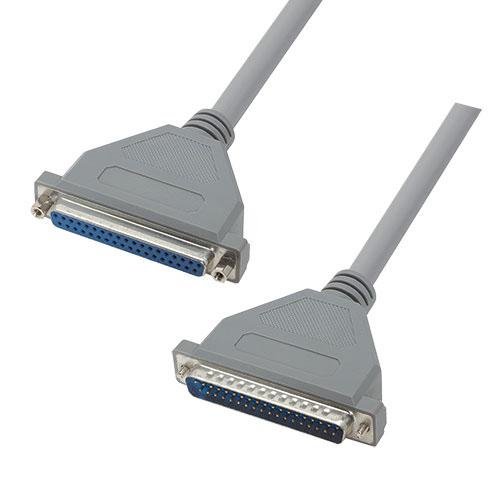
An engineer from Mexico, working on automotive simulation testing equipment, contacted us regarding a custom cable assembly.
The initial specification was simple:
- D-Sub 37-pin male connector;
- D-Sub 37-pin female connector;
- 37 conductors connected pin-to-pin;
- Cable length of approximately 40 cm.
Many suppliers would immediately issue a quotation based solely on these details.
After all, it was “just a DB37 extension cable.”
However, our experience has taught us that in engineering, simple drawings often hide complex requirements.
The true challenge lies not in assembling the cable, but in understanding the environment in which it will operate.
Looking Beyond the Drawing
Before preparing the final proposal, we discussed several practical questions with the customer.
How often would the cable be connected and disconnected?
A cable installed once and left untouched has very different requirements from one used repeatedly during daily testing procedures.
Frequent mating cycles place additional demands on connector durability and assembly robustness.
Would the cable experience vibration or movement?
Automotive testing environments often involve:
- repeated handling,
- movement of test fixtures,
- equipment vibration.
Without adequate strain relief and proper assembly techniques, these conditions can shorten the service life of the cable assembly.
Were there signal integrity concerns?
Although all 37 conductors followed a one-to-one configuration, understanding the nature of the signals remained important.
Questions included:
- Were sensitive sensor signals involved?
- Was electromagnetic interference a concern?
- Would shielding improve testing reliability?
These considerations influence cable selection and overall system performance.
The Hidden Debate: Cost Versus Quality
As with most engineering projects, cost was an important consideration.
The customer wanted a reliable solution while maintaining reasonable budget control.
This led to a discussion that many engineering teams face every day:
How can we optimize cost without compromising quality?
From the outside, two DB37 cable assemblies may appear identical.
However, important differences often exist beneath the surface.
| Engineering Factor | Lower-Cost Option | Reliability-Oriented Option |
|---|---|---|
| Cable Material | Generic cable | UL-recognized cable |
| Connector Grade | Commercial grade | Industrial-grade connector |
| Strain Relief | Standard | Reinforced design |
| Testing Method | Sample inspection | 100% electrical testing |
| Traceability | No batch records | Full production traceability |
The objective was never to create the most expensive solution.
Nor was it to pursue the lowest possible price.
Instead, the goal was to determine the most appropriate balance between performance, reliability, and cost.
In engineering applications, the lowest purchase price does not always represent the lowest total cost of ownership.
Why Certifications Matter
Another important topic during the discussion involved material compliance and certification requirements.
Although this cable assembly was intended for testing applications, certified materials still offered several advantages.
These include:
- consistent material quality;
- reduced supply chain uncertainty;
- improved traceability;
- compliance with customer requirements;
- greater confidence in long-term performance.
Depending on the project requirements, commonly requested standards may include:
- UL-recognized wire;
- RoHS compliance;
- REACH compliance;
- documented supplier quality systems.
Certification alone does not guarantee quality.
However, it provides an important foundation for building reliable products.
Quality Cannot Be Inspected Into a Product
One of the most important lessons in manufacturing is that quality cannot be added at the end of production.
Quality must be built into the process itself.
For cable assemblies used in demanding environments, this principle becomes especially important.
At WireAssyTech, quality control begins long before final inspection.
Incoming Material Verification
Materials should first be confirmed against engineering requirements.
Typical verification activities include:
- checking cable specifications;
- confirming connector models;
- reviewing supplier documentation;
- inspecting incoming materials for defects.
Controlled Assembly Processes
Consistency during assembly plays a critical role in final product reliability.
Process controls may include:
- standardized work instructions;
- operator training;
- process verification checkpoints;
- proper handling and assembly techniques.
These practices help reduce variation and improve repeatability.
Final Inspection and Testing
Before shipment, electrical verification provides an additional layer of confidence.
Depending on project requirements, testing activities may include:
- 100% continuity testing;
- pin-to-pin verification;
- visual inspection;
- product labeling and identification.
Where necessary, production records can also be retained to support future traceability requirements.
Quality is not a single inspection activity.
It is a discipline applied throughout the manufacturing process.
The Real Cost of Failure
During the quotation stage, price differences between suppliers often attract significant attention.
However, the consequences of field failures are rarely reflected in the original purchase order.
Potential costs associated with cable failures may include:
- troubleshooting labor;
- unexpected production downtime;
- emergency replacement shipments;
- delayed project schedules;
- customer dissatisfaction.
In automotive testing applications, unstable test results can consume valuable engineering resources and extend development timelines.
In many cases, the true cost of failure far exceeds the initial savings achieved through aggressive cost reduction.
What This Project Taught Us
What began as a request for a 40 cm DB37 cable assembly evolved into a broader discussion about engineering responsibility.
The experience reinforced several important lessons.
A cable assembly should not be defined solely by its drawing.
The working environment matters.
The expected service life matters.
Certification requirements matter.
Quality control matters.
Cost matters.
Most importantly, these factors must be considered together rather than independently.
The best solution is rarely the cheapest option.
Likewise, the most expensive option is not automatically the right choice.
The objective is to provide a solution that delivers the required level of reliability at an appropriate cost.
Final Thoughts
For engineers, a cable assembly is more than a collection of connectors and wires.
It is part of a larger system whose performance depends on every component functioning reliably.
As manufacturers, our responsibility extends beyond simply building to print.
It includes asking the right questions, understanding the application environment, and helping customers identify potential risks before they become costly problems.
Because in automotive testing environments, preventing failure is almost always less expensive than correcting it later.
Sometimes, the most valuable contribution a supplier can make is not providing the lowest quotation.
It is helping engineers make informed decisions that balance cost, quality, compliance, and long-term reliability.
That is the difference between supplying a cable assembly and delivering an engineering solution.