In medical diagnostics, particularly with ECG (Electrocardiogram) monitoring, the integrity of a micro-volt signal is non-negotiable. A common failure mode reported by field engineers is signal “jumping” or baseline drift after only a few dozen mating cycles. This is almost always traceable to a spike in Contact Resistance (R-contact) and a breakdown in EMI shielding.
At wireassytech.com, our 15 years of experience in ISO 13485 certified medical cable manufacturing has shown that solving these issues requires a transition from “commercial-grade” thinking to “interconnect physics.”
1. 【Scenario Pain Points】 Why ECG Signals “Jump”
The “jumping” of an ECG trace is typically the result of two converging engineering failures:
- Fretting Corrosion & Plating Wear: Standard connectors often use thin gold flash or tin plating. After repeated mating, the base metal (usually brass or phosphor bronze) is exposed, leading to oxidation. This creates a non-linear resistance that fluctuates with the slightest mechanical vibration, causing signal spikes.
- Triboelectric Noise: In medical environments, the movement of the cable itself can generate internal static charges (the triboelectric effect). Without a specialized “low-noise” layer between the dielectric and the shield, this charge manifests as artifact noise on the ECG monitor.
- Sterilization Degradation: Repeated exposure to IPA (Isopropyl Alcohol) or Autoclave cycles can embrittle standard PVC jackets, leading to micro-cracks that allow moisture ingress, further destabilizing the electrical path.
2. 【Material & Connector Selection Analysis】
To maintain a stable baseline, the material bill must prioritize biocompatibility and electrical consistency.
High-Reliability Connectors
- Medical Circulars (LEMO Redel / ODU Medi-Snap): These utilize a “Push-Pull” self-latching mechanism. For ECG applications, we specify contacts with a minimum of 30μ” Gold (Au) plating over 50μ” Nickel (Ni) to ensure stable contact resistance even after 2,000+ mating cycles.
- Cost-Effective Alternatives (CJT A2005 Series): For high-mix, cost-sensitive projects, CJT’s 2.0mm pitch medical-grade connectors offer a reliable alternative to JST or Molex, provided the plating specifications are elevated to medical standards.
Cable Architecture
- Conductor: AWG 28 to AWG 30 ultra-fine stranded tinned copper for maximum flexibility.
- Insulation & Jacket: Medical-grade TPU (Thermoplastic Polyurethane) or Silicone. TPU is preferred for its superior resistance to skin oils and chemical disinfectants.
- Low-Noise Construction: A semi-conductive graphitized layer is applied between the insulation and the Tinned Copper Braid (85% coverage) to dissipate triboelectric charges.
3. 【Technical Parameter Comparison】 Standard vs. Medical Grade
| Parameter | Standard Commercial Assembly | Medical-Grade Integrated Solution |
| Connector Series | Molex Micro-Fit (Standard) | LEMO Redel / CJT Medical Series |
| Mating Cycles | < 100 Cycles | > 2,000 Cycles |
| Contact Resistance | Initially < 20mΩ (Increases rapidly) | Stable < 10mΩ throughout service life |
| Shielding Type | Aluminum Foil only | Foil + 85% Tinned Copper Braid |
| Jacket Material | Standard PVC (UL1007/1061) | Biocompatible TPU / Silicone |
| Sterilization Support | None | IPA Wipe / Gamma / EtO Compatible |
4. 【DFM Advice】 Designing for Signal Integrity
- Specify “Wiping Action” Contacts: Ensure the connector design includes a mechanical wipe during mating. This helps clear surface oxides and ensures a fresh metal-to-metal interface for every use.
- Symmetry in Shield Termination: To minimize EMI loop areas, the cable shield must be terminated 360° to the connector shell. Avoid “pigtail” terminations, which act as antennas for 50/60Hz power line interference.
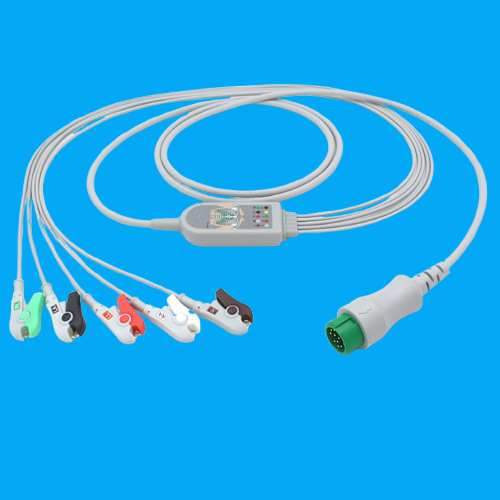
- Overmolded Strain Relief: For ECG leads, the transition from cable to connector is a high-stress point. We recommend overmolding with TPU to provide a graduated transition in stiffness, preventing internal strand breakage and intermittent contact.
- Vertical Integration (PCB + Harness): If the ECG signal is processed on an internal board before exiting the device, ensure the PCBA layout separates the high-gain analog front-end from digital switching noise. At wireassytech.com, we manage both the PCBA and the harness to ensure the entire signal path is impedance-matched and noise-isolated.
Precision Interconnects for the HMLV Era
In the Medical Device industry, the transition from a prototype to a compliant, market-ready product requires a partner who understands the nuances of ISO 13485 and IATF 16949.
At wireassytech.com, we specialize in High-Mix Low-Volume (HMLV) production. We understand that you may only need 100 high-spec ECG lead sets for a clinical trial, but you need them to be perfect. Our vertical integration—handling everything from PCB assembly to custom cable overmolding—ensures that there is no “finger-pointing” between vendors when signal integrity issues arise.
Facing baseline noise or connector wear issues in your medical device? Contact our engineering team today for a comprehensive DFM review and rapid prototyping service.