With the explosive growth of Large Language Models (LLMs) and generative AI, the demand for computing power has reached unprecedented levels. In modern AI servers—often packed with high-performance GPUs like the NVIDIA H100 or AMD MI300—the bottleneck is no longer just the chips themselves. The real challenge lies in internal high-speed interconnects.
When designing the internal routing for next-generation AI hardware, hardware engineers and procurement managers face a critical choice: Should you use MCIO or SlimSAS?
In this article, we will compare these two prominent interconnect standards across technical specifications, signal integrity, and space efficiency to help you make the best architectural decision for your AI servers.
What is SlimSAS (SFF-8654)?
SlimSAS (formally known as SFF-8654) has been the workhorse of enterprise servers and storage devices over the past few years. Originally designed for SAS 4.0 (24Gbps) and PCIe 3.0/4.0 protocols, it provided a reliable way to connect storage backplanes and PCIe devices.
- The Pros: A highly mature ecosystem, cost-effective, and widely supported by legacy hardware.
- The Limitations: As server architectures transition to PCIe 5.0 (32 GT/s) and the upcoming PCIe 6.0 (64 GT/s), SlimSAS struggles. Its physical footprint and pin layout can lead to signal degradation and crosstalk at extreme high frequencies, making it less suitable for cutting-edge AI nodes.
What is MCIO (Mini Cool Edge IO / SFF-TA-1016)?
MCIO (Mini Cool Edge IO, standardized as SFF-TA-1016) is the next-generation connector born specifically to break bandwidth barriers. It natively supports PCIe 5.0, PCIe 6.0, and CXL (Compute Express Link) protocols.
- The Pros: Exceptional Signal Integrity (SI), a significantly smaller footprint, and ultra-low insertion loss.
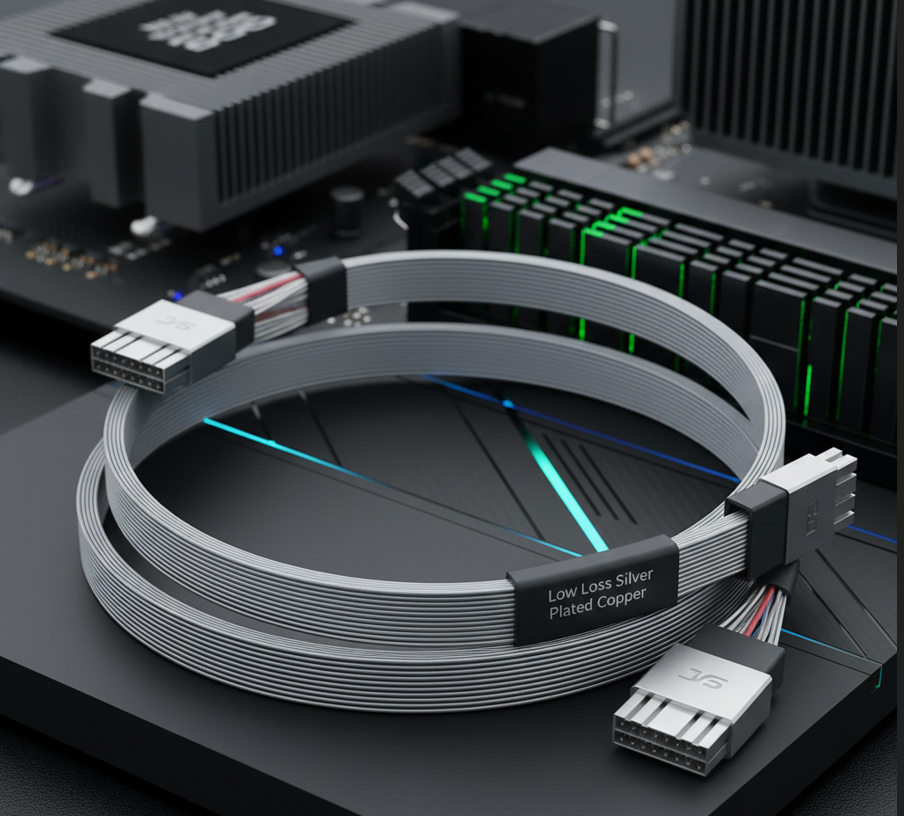
- The Design Philosophy: MCIO is built on the concept of “Cable Routing”—taking high-speed signals off the PCB and transmitting them through twinax cables instead. This drastically reduces signal loss over long distances, which is crucial for AI servers requiring hundreds of high-speed lanes between CPUs, GPUs, and NVMe SSDs.
The Core Comparison: MCIO vs. SlimSAS
To give you a clear perspective, here is a technical comparison table (Highly recommended for R&D and Sourcing teams):
| Feature / Specification | SlimSAS (SFF-8654) | MCIO (SFF-TA-1016) |
| Primary Standard | PCIe 3.0 / PCIe 4.0 | PCIe 5.0 / PCIe 6.0 & CXL |
| Max Speed per Lane | 16 GT/s (PCIe Gen 4) | 32 GT/s up to 64 GT/s (PAM4) |
| Signal Integrity (SI) | Good for medium speed/distance | Exceptional; ultra-low crosstalk and insertion loss |
| PCB Footprint | Larger | 15% – 20% smaller than SlimSAS |
| Profile & Airflow | Can obstruct cooling paths | Low-profile design; highly optimized for airflow |
| Best Application | Traditional servers, Storage (JBOD), NVMe | AI Servers, GPU computing nodes, PCIe 5.0 Backplanes |
Why AI Servers Are Rapidly Adopting MCIO
If you are developing or sourcing components for AI server systems, MCIO is undeniably the superior choice. Here is why:
1. Meeting Strict PCIe 5.0 & 6.0 Signal Integrity Demands
AI workloads require massive data exchange between GPUs and CPUs. At PCIe 5.0 speeds (32 GT/s), transmitting signals through a traditional PCB for more than a few inches results in severe signal attenuation. MCIO cables act as a high-speed “overpass” above the motherboard, ensuring zero-packet-loss data transmission directly to GPU backplanes or high-speed NVMe storage.
2. Ultimate Space Utilization and Thermal Management
AI servers generate immense heat. The MCIO connector is significantly smaller and features a lower profile than SlimSAS. Not only does it save premium real estate on the motherboard, but more importantly, it does not block cooling airflow. Better airflow means GPUs stay cool, preventing thermal throttling and maintaining peak compute performance.
3. Future-Proofing Your Hardware Architecture
The iteration cycle of AI hardware is incredibly fast. The SFF-TA-1016 (MCIO) standard is already designed to handle PCIe 6.0 (which uses PAM4 modulation). By adopting MCIO now, you ensure your server architecture is ready for the next 3 to 5 years of hardware upgrades without needing a complete motherboard redesign.
Conclusion: Which One Should You Choose?
- Choose SlimSAS if: You are building traditional enterprise servers, storage expansion nodes, or systems that primarily operate on PCIe 4.0. It remains the most cost-effective and proven solution for legacy tech.
- Choose MCIO if: You are designing AI servers, Machine Learning workstations, High-Performance Computing (HPC) clusters, or heavily populated GPU chassis. For PCIe 5.0 and beyond, MCIO is the mandatory standard to prevent data bottlenecks.
Looking for a Reliable MCIO / SlimSAS Cable Manufacturer?
As a professional manufacturer specializing in high-speed interconnect solutions, [Your Company Name] is dedicated to providing top-tier cabling solutions for global server system integrators, data centers, and hardware R&D teams.
Why partner with us?
- ✅ Industry Compliant: Full range of MCIO (PCIe 5.0/6.0) and SlimSAS cable assemblies meeting strict SFF specifications.
- ✅ Tailored Customization: We customize cable lengths, wire gauges (AWG), and connector orientations (Straight, Right Angle, Side Exit) to perfectly fit your unique server chassis design.
- ✅ Rigorous Quality Control: Every single cable undergoes 100% Signal Integrity (SI) testing (using Network Analyzers) before shipping to ensure flawless performance.
Not sure which exact spec your architecture needs?
Our dedicated team of interconnect engineers is ready to assist you with layout strategies and technical drawings.
(Note: When inquiring, please provide your motherboard and device-end interface types so we can match you with the most precise cabling solution.)