How Cable Assemblies Are Designed for Industrial Applications
In the world of industrial automation, robotics, and heavy manufacturing, a cable failure is never just a minor inconvenience—it means catastrophic system downtime, halted production lines, and thousands of dollars in lost revenue per minute.
Unlike standard commercial cables, industrial cable assemblies are mission-critical lifelines. They must transmit power, data, and control signals flawlessly while surviving the most unforgiving environments on Earth.
But how exactly is a rugged industrial cable assembly engineered from concept to production? In this article, we take a deep dive into the engineering and design process behind high-performance industrial cable solutions.
Phase 1: Environmental Assessment (Defining the Threat)
The design process of an industrial cable assembly always begins not with the wire itself, but with the environment it will operate in. Engineers must conduct a thorough application analysis to identify potential “threats” to the cable:
- Mechanical Stress: Will the cable be static, or will it be used in a continuous-flex application (like a robotic arm or a C-track system)? This determines the required flex-cycle rating (e.g., 5 million vs. 10 million cycles).
- Chemical & Liquid Exposure: Will the cable be exposed to machine oils, cutting fluids, harsh cleaning chemicals, or continuous submersion in water?
- Temperature Extremes: Does the application involve blast furnaces (+200°C) or cryogenic freezing facilities (-40°C)?
- Electromagnetic Interference (EMI): In factories with heavy motor drives and welding equipment, electrical noise can corrupt data signals. EMI/RFI shielding is critical.
Phase 2: Strategic Material Selection
Once the environmental challenges are identified, engineers select the exact materials to combat them.
1. Conductor Design
For static applications, solid copper conductors may suffice. However, for dynamic industrial applications (like automation equipment), high-strand-count bare or tinned copper is used. The finer the strands, the higher the flexibility and fatigue resistance.
2. Insulation and Jacket Materials
The outer jacket is the cable’s first line of defense. Selecting the right polymer is crucial:
- PVC (Polyvinyl Chloride): Cost-effective, good for general light-industrial use.
- PUR (Polyurethane): Excellent resistance to abrasion, tearing, and industrial oils. Highly recommended for robotics and machining centers.
- TPE (Thermoplastic Elastomer): Highly flexible, performing exceptionally well in continuous-flex applications and extreme temperatures.
- Teflon/PTFE: Used for extreme high-temperature environments and aggressive chemical resistance.
3. EMI/RFI Shielding
To protect sensitive data protocols (like Industrial Ethernet, Profinet, or EtherCAT) from factory noise, engineers utilize braided tinned copper shields (providing up to 85%-95% coverage) combined with aluminum foil wrapping.
Phase 3: Connector Selection and Overmolding
An industrial cable is only as strong as its weakest link—which is usually the connection point.
- Rugged Connectors: Industrial assemblies typically utilize robust circular connectors (such as M8, M12, M23) or heavy-duty rectangular connectors. These feature secure locking mechanisms (threaded or push-pull) to withstand heavy vibration.
- Overmolding Technology: To achieve true IP67 or IP68 waterproof and dustproof ratings, custom cable manufacturers use injection overmolding. This process encases the connector and the cable junction in a solid resin or TPU/PVC shell. Overmolding provides superior strain relief, prevents liquid ingress, and ensures the wires cannot be pulled out of the connector body under heavy tension.
Quick Comparison: Commercial vs. Industrial Cables
Here is why you cannot use off-the-shelf commercial cables in industrial settings:
| Feature | Standard Commercial Cables | Engineered Industrial Cables |
| Flexibility / Lifecycle | Low (Static use) | Millions of continuous flex cycles |
| Jacket Material | Basic PVC | PUR, TPE, or PTFE (Oil & UV resistant) |
| Shielding | Minimal to none | Double shielding (Foil + Copper Braid) |
| Ingress Protection | IP20 (Indoor only) | IP67, IP68, IP69K (Washdown ready) |
| Strain Relief | Basic slip-on boot | Custom injection overmolding |
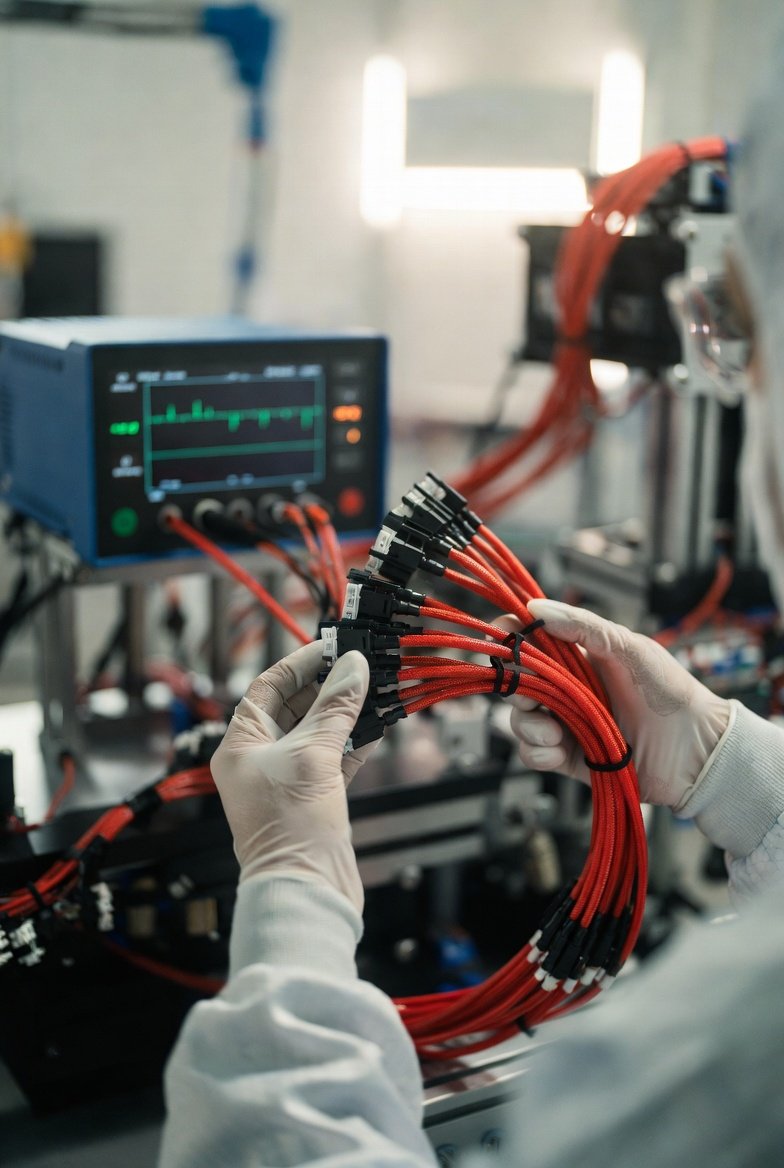
Phase 4: Rigorous Testing and Quality Assurance
Before an industrial cable assembly goes into mass production, prototypes must pass a battery of brutal tests to ensure total reliability:
- Continuity and Hi-Pot Testing: Ensures there are no miswires, shorts, or insulation breakdowns under high voltage.
- Pull Force / Tensile Testing: Verifies that the crimps, soldering, and overmolding can withstand the physical pulling forces specified by the OEM.
- Flex Cycle Testing: Cables are placed in “Tick-Tock” or C-Track testing machines to bend back and forth millions of times to simulate years of robotic movement.
- Environmental Chambers: Cables are baked, frozen, and exposed to salt spray to guarantee longevity in harsh climates.
Need Custom Industrial Cable Assemblies for Your Project?
Designing an industrial cable assembly requires deep engineering expertise. Partnering with the right manufacturer ensures your equipment runs flawlessly, avoiding costly downtime and warranty claims.
At [Your Company Name], we specialize in the custom design, prototyping, and high-volume manufacturing of rugged industrial cable assemblies and wire harnesses. Whether you need M12 industrial ethernet cables, complex robotic harnesses, or heavy-duty overmolded solutions, we have the capabilities to deliver.
What we offer to global OEMs:
- ✅ End-to-End Engineering Support: From material selection to CAD drawings and rapid prototyping.
- ✅ Harsh Environment Expertise: Waterproof (IP68), oil-resistant, and high-flex solutions.
- ✅ Stringent Quality Control: 100% electrical and physical testing before shipment. ISO-certified manufacturing.
Send us your specifications, CAD drawings, or simply tell us about your application challenges. Our engineering team will design a solution tailored exactly to your needs.
(Please include your application environment, estimated volumes, and any technical drawings for a faster technical response.)