Biomimicry, Smart Power Distribution, and the Future of Intelligent Wire Harness Design
Last summer, I was walking outside with my daughter when she pointed at a firefly and asked a simple question: “Why does it blink instead of staying on all the time?”
At first, it sounded like one of those innocent questions children ask every day. But the more I thought about it, the more interesting it became. If the purpose of a firefly is to produce light, wouldn’t it be simpler to keep the light on continuously? Why flash? Why turn it on and off? Why build such a complicated system just to create a brief pulse of light?
As engineers, we often assume that nature’s solutions are simple. In reality, they are often astonishingly sophisticated. The answer to this tiny insect’s blinking behavior reveals a design philosophy that modern automotive engineers, robotics designers, and wire harness manufacturers are increasingly adopting today.
Surprisingly, it may offer valuable insights into one of the biggest challenges facing modern vehicles: How do we deliver power and information with less wiring, less weight, and less wasted energy?
The Firefly Is Not a Biological Light Bulb
Most people think of a firefly as a glowing insect. From an engineering perspective, however, a firefly is something entirely different: it is a highly optimized energy management system. The remarkable thing is not that it produces light; the remarkable thing is that it only produces light when necessary. To understand why that matters, we first need to understand how a firefly actually works. The light-producing reaction inside a firefly requires four key ingredients:
- Luciferin (The substrate)
- Luciferase (The enzyme)
- ATP (Cellular energy)
- Oxygen (The catalyst/trigger)
When these components come together, light is produced with extraordinary efficiency. Unlike traditional incandescent bulbs, which waste most of their energy as heat, firefly bioluminescence converts nearly all of its energy into visible light. Scientists estimate that this biological efficiency can exceed 90%. For comparison, many conventional automotive lighting systems are dramatically less efficient.
At first glance, this hyper-efficient reaction seems to be the secret. But it isn’t. The real secret lies elsewhere.
The Question Engineers Should Ask
Most articles ask: “How does a firefly make light?” Engineers should ask a different question: “Why doesn’t it glow all the time?”
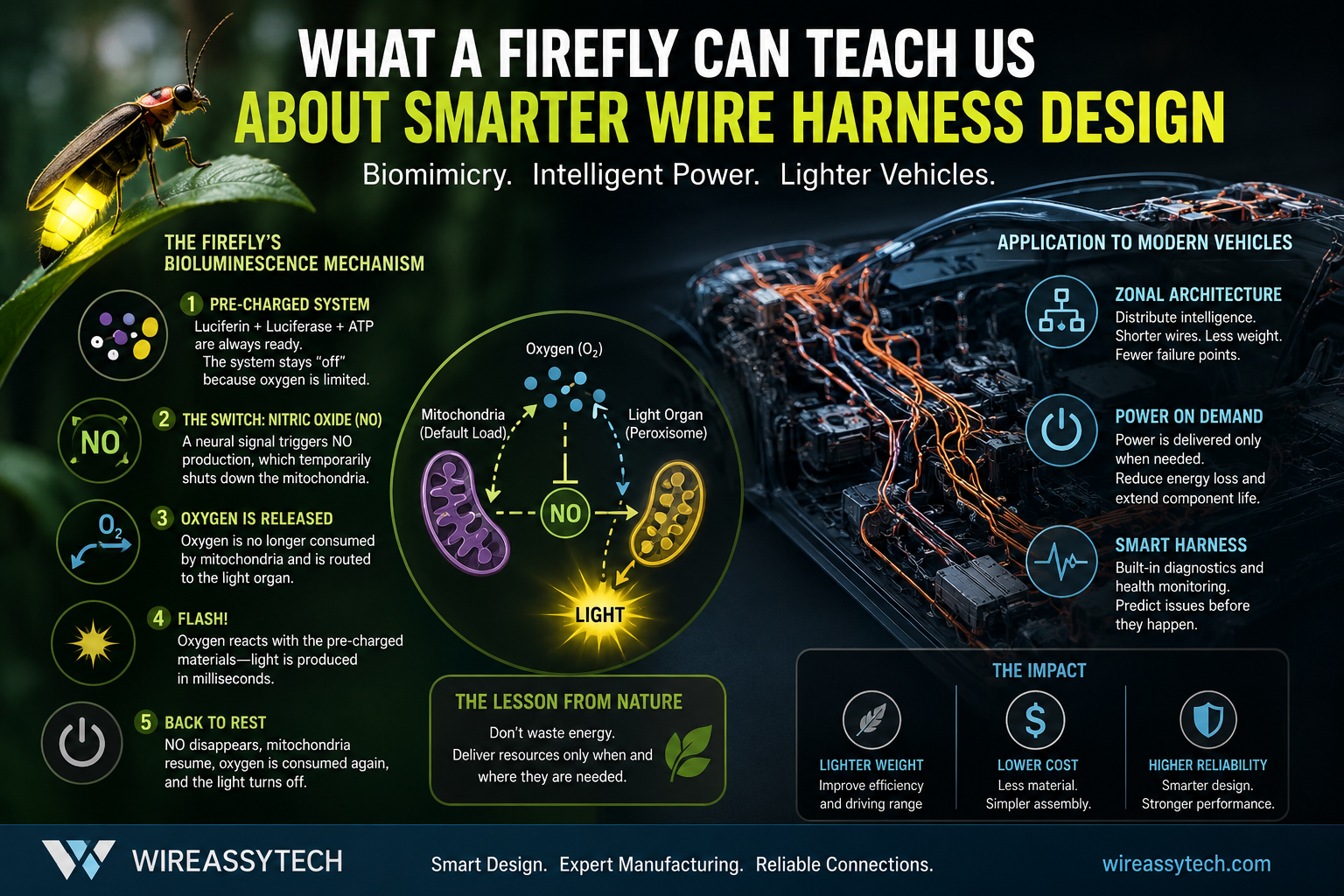
This is where things become fascinating. Inside the firefly’s light-producing cells, most of the required ingredients—luciferin, luciferase, and ATP—are already present. The system is essentially preloaded and ready to generate light at any moment. Yet, nothing happens.
Imagine a machine connected to a power source. The electronics are installed, the software is loaded, and the hardware is ready—but the machine remains off. Why? Because one critical resource has been deliberately restricted. In the firefly’s case, that resource is oxygen.
Nature’s Resource Routing System
Under normal conditions, oxygen entering the cell is consumed by mitochondria to support the firefly’s normal biological functions. In simple engineering terms, the mitochondria act like the system’s default load. As long as oxygen is being consumed there, it cannot reach the light-producing reaction, and the light remains off.
Then comes the clever part:
- The Signal: When the firefly decides to flash, its nervous system sends a signal to the light organ.
- The Interruption: That signal triggers the production of nitric oxide, which temporarily suppresses mitochondrial oxygen consumption. The default load is effectively switched off.
- The Routing: Suddenly, oxygen is free to flow elsewhere. It rushes toward the light-producing structures where it reacts with luciferin.
- The Pulse: The result is an instantaneous flash of light.
- The Reset: When the signal stops, nitric oxide quickly disappears, mitochondria resume consuming oxygen, and the light shuts off within milliseconds.
💡 The Core Design Principle
Do not keep resources flowing when no useful work is being performed.
The firefly doesn’t simply generate light efficiently; it manages resources intelligently. This principle appears repeatedly throughout nature, and increasingly, it is appearing throughout modern engineering.
The Problem With Traditional Vehicle Wiring
Now let’s leave the forest and step into a modern vehicle. Most drivers never think about the wire harness hidden beneath the body panels, yet it is one of the most critical and heavy systems in the vehicle.
Modern vehicles contain hundreds of electrical devices that require constant connectivity:
- Cameras, Radar, and LiDAR systems
- Infotainment modules and lighting systems
- Battery management systems and electric motors
- Safety controllers and advanced sensors
Historically, the automotive solution to adding features was simple: run more wires. As electronic complexity increased, harness complexity exploded. The result? Some modern vehicles now contain several kilometers of wiring, with harness weights exceeding 80 kilograms.
This extra wiring creates a massive engineering burden, resulting in more copper usage, higher costs, increased installation time, and more potential failure points. For electric vehicles (EVs), where every kilogram directly impacts driving range, this is no longer sustainable.
The Rise of Zonal Architecture
If a firefly were designing a vehicle, it wouldn’t simply keep adding more wires. Its strategy would be based on intelligent resource allocation: How do we activate only what is needed?
For decades, automotive electrical systems relied on Centralized Control, requiring long wiring runs from every distant device back to one main controller. Today, vehicle manufacturers are rapidly shifting toward Zonal Architecture, where multiple local controllers manage specific regions of the vehicle.
Centralized vs. Zonal Architecture
| Feature | Traditional Centralized Architecture | Modern Zonal Architecture |
| Control Center | One massive central controller | Multiple local regional controllers (Front, Rear, Sides) |
| Wiring Length | Long, heavy cable runs spanning the entire vehicle | Shorter, localized cable lengths |
| Weight & Copper | High weight (up to 80+ kg), high copper costs | Significantly reduced copper and lower weight |
| Data Flow | All raw data travels to the central brain | Local processing occurs within the zone; only essential data travels |
| Diagnostics | Complex troubleshooting | Simplified assembly and easier diagnostics |
This concept closely resembles biological nervous systems. Not every signal travels directly to the brain; local processing occurs throughout the organism. Nature discovered distributed intelligence long before engineers did.
From Always-On to On-Demand Power
The firefly teaches another valuable lesson: eliminate the “always-on” penalty. Many legacy automotive systems remain energized even when inactive. Future vehicle architectures are shifting toward on-demand power distribution.
Consider a vehicle door module:
- Traditional Approach: Circuits remain fully energized continuously, waiting for an action.
- Biomimetic Approach: A proximity sensor detects a user approaching. The local controller wakes up, distributes power, executes the window or lock action, and immediately returns the system to sleep mode.
This approach reduces standby energy consumption, minimizes thermal stress, and extends component life. Activate only when necessary; deactivate immediately afterward.
Smart Harnesses: The Next Evolution
Traditionally, a wire harness was viewed as a passive component—a dumb pipe to connect Point A to Point B. That view is rapidly becoming outdated. Modern harnesses are transforming into intelligent infrastructure capable of:
- Dynamic power routing
- Continuous health monitoring & real-time fault detection
- Predictive maintenance & embedded diagnostics
Rather than solving engineering problems by adding more physical hardware (more modules, connectors, and copper), engineers are using software, networking, and distributed control to add intelligence. The future of wire harnesses is not more wiring; it is smarter wiring.
What This Means for Wire Harness Designers
For harness engineers, the implications are significant. The next generation of successful designs will not be defined solely by current capacity, connector selection, or mechanical durability. Additional, system-level questions are emerging:
- Can power be distributed more intelligently to eliminate unnecessary conductors?
- Can functions be localized to reduce overall cable length?
- Can software and smart routing reduce physical hardware requirements?
- Can diagnostics be built directly into the harness infrastructure?
Evolution has been running engineering experiments for hundreds of millions of years. Every organism alive today represents a solution that survived an extraordinarily demanding testing environment. The firefly’s flashing mechanism proves that true efficiency is not merely about converting energy effectively—it is about managing the movement of resources throughout a system.
Final Thoughts
The greatest achievement of the firefly is not that it can produce light. The greatest achievement is that it knows exactly when to produce light—and when to stay dark.
As automotive electronic content continues to grow, simply adding more copper is a dead end. The future belongs to architectures that deliver power and information more intelligently: less unnecessary weight, less wasted energy, more localized control, and smarter resource management.
At WireAssyTech, we believe great wire harness design begins with understanding the entire system, not just the cables inside it. Whether supporting electric vehicles, industrial automation, medical equipment, robotics, or advanced electronics, our goal is simple:
Deliver the right power and the right information to the right place at the right time—with the highest reliability and the lowest possible complexity.
Sometimes the most valuable engineering lessons don’t come from multi-million dollar laboratories. Sometimes, they come from a tiny insect flashing in the dark.