Outdoor Industrial / IoT
Codex-Assisted Design → Prototype → Production
From Codex Prompt to Delivered Cable in 16 Days:
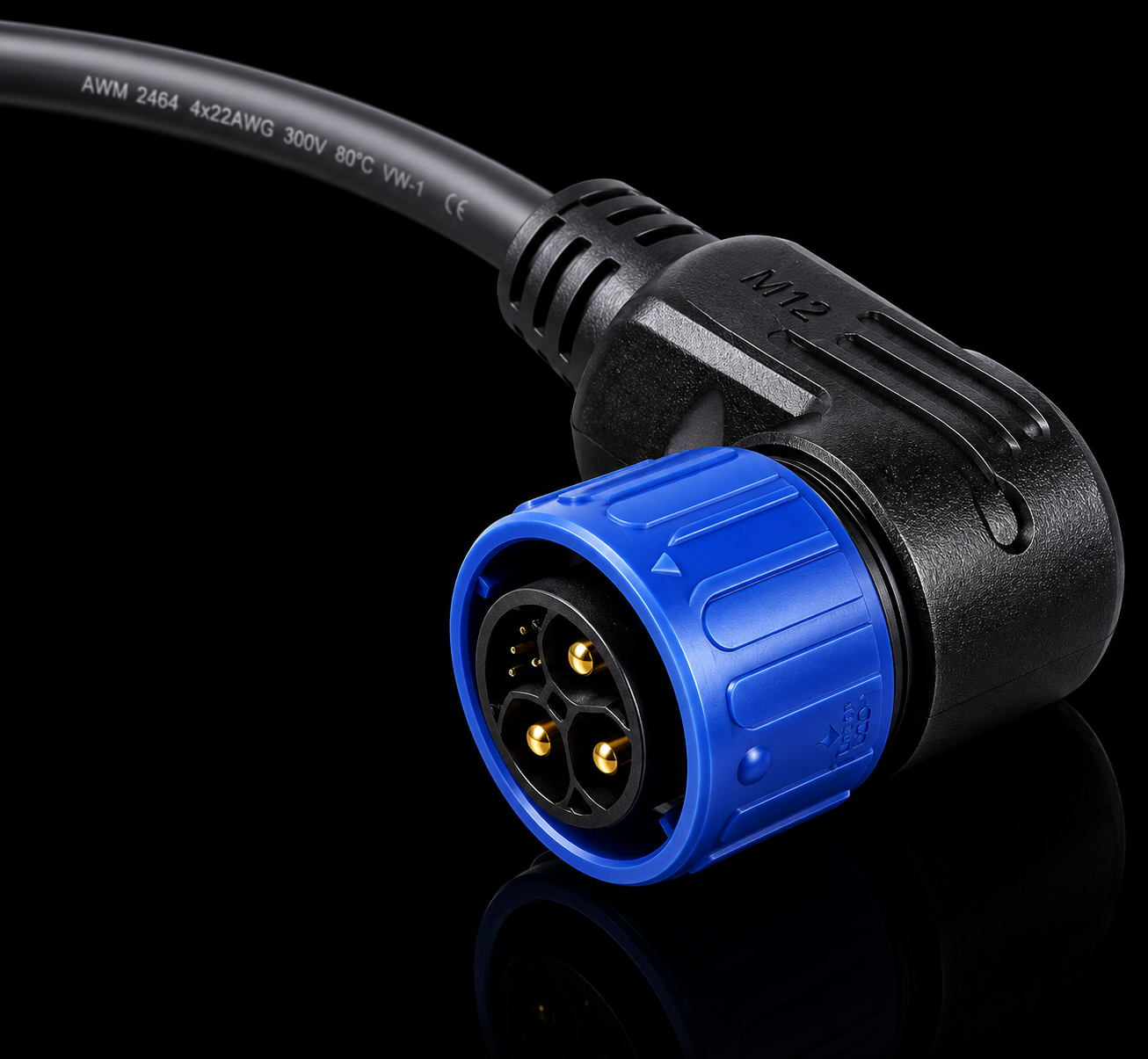
IP67 M12 Right-Angle Waterproof Connector Assembly
An engineer designing an outdoor sensor node used OpenAI Codex to generate the complete cable specification — wire list, BOM, DFM checklist, and test procedure — before sending a single email to a manufacturer. Here is the exact workflow, with the prompts used.
16
Days from first prompt to delivery
IP67
Waterproof rating achieved
3
DFM issues caught by Codex
0
Prototype rework required
01
The Engineer’s Situation
A hardware engineer at an IoT startup was building an outdoor environmental monitoring node — temperature, humidity, and particulate sensors mounted on utility poles and building rooftops. The device needed a field-replaceable cable connecting the sensor head to a junction box, rated for outdoor exposure in rain, dust, and temperature extremes.
The connector choice was clear in principle: a circular waterproof connector with IP67 rating, locking mechanism for vibration resistance, and a right-angle exit to keep the cable parallel to the mounting surface. What was not clear was exactly which connector family, which pin configuration, what wire gauge, and how to specify the overmold correctly.
Rather than spending two days researching connector datasheets and writing a specification from scratch, the engineer opened ChatGPT with Codex and started with a single prompt.
💬
“I knew what I needed functionally — waterproof, lockable, right-angle, 5 signals. I did not know how to translate that into a manufacturable specification. Codex gave me a first draft in four minutes. I spent the next hour refining it rather than the next two days building it.”
02
Step 1 — Connector Selection via Codex
The engineer’s first prompt was a connector selection query. This is one of the most time-consuming parts of cable assembly design — there are hundreds of circular waterproof connector families, and choosing the wrong one early means redesigning the PCB footprint later.
📋 Prompt used
I need a circular waterproof connector for an outdoor IoT sensor cable. Requirements:
– IP67 minimum rating
– 5 contacts: 2x power (12V, 2A max), 3x signal (I2C: SDA, SCL, GND)
– Right-angle cable exit (cable runs parallel to mounting surface)
– Field-removable: technicians need to disconnect it without tools
– Operating temperature: -40°C to +85°C
– Cable OD approximately 6–8mm
– Target unit cost under $3.00 for the connector pair at 500 pcs
Compare M12, M8, and Amphenol Circular Mate families for this application.
Recommend the best option and explain why.
Include the standard series name, IP rating method (IEC 60529), and locking mechanism type.
Codex returned a detailed comparison of M8, M12, and competing families, recommending M12 A-coding with a screw-locking mechanism — the dominant standard for industrial sensor connections at this signal and power level. It explained that M8 was marginally undersized for the 2A power requirement, and that proprietary circular formats would add cost without benefit at this volume.
✅ Output from Codex
Connector selected: M12 A-code, 5-pin, male panel mount (sensor head) + female right-angle cable connector, screw locking, IP67 per IEC 60529 when mated. Estimated connector pair cost: $1.80–$2.40 at 500 pcs from standard industrial suppliers.
⚠️
Codex correctly identified the connector family but suggested a specific part number that had been superseded. Always verify part numbers on the manufacturer’s current catalog before adding to a BOM. The connector family recommendation was accurate; the exact part number needed one correction.
03
Step 2 — Wire List and BOM Generation
With the connector family confirmed, the engineer used a second Codex prompt to generate the complete wire list and BOM. This is where Codex saves the most time — structured data generation that would otherwise require manual cross-referencing of multiple datasheets.
📋 Prompt used
Generate a complete wire list and BOM for the following cable assembly:
Connector: M12 A-code 5-pin, female right-angle cable connector (IP67)
Cable: ~1000mm overall length
Signals:
Pin 1 — 12V Power (VCC), 2A max
Pin 2 — Ground (GND), shared power and signal return
Pin 3 — I2C SDA
Pin 4 — I2C SCL
Pin 5 — Shield / Chassis ground
Requirements:
– Operating temperature: -40°C to +85°C
– Outdoor UV exposure
– IEC 60227 or UL listed wire
– Shielded cable preferred for I2C signal integrity
Wire list table: Pin | Function | Wire Color (IEC 60757) | AWG | Notes
BOM table: Item | Description | Specification | Qty/unit | Notes
Flag any items where outdoor UV resistance affects material selection.
| Pin |
Function |
Wire Color |
AWG |
Notes |
| 1 |
12V Power (VCC) |
Red |
AWG 22 |
Rated 3A minimum; 2A operating with thermal margin |
| 2 |
Ground (GND) |
Black |
AWG 22 |
Shared power and signal return; sized for full 2A |
| 3 |
I2C SDA |
Blue |
AWG 26 |
Twisted pair with SCL recommended for noise immunity |
| 4 |
I2C SCL |
White |
AWG 26 |
Twisted pair with SDA |
| 5 |
Shield / Chassis GND |
Bare drain wire |
AWG 24 |
Connected to cable braid shield; single-end termination at sensor head |
Codex also flagged that standard PVC jacket would degrade under prolonged UV exposure and recommended TPU (thermoplastic polyurethane) or LSZH (Low Smoke Zero Halogen) jacket compound for outdoor applications — a detail that is easy to miss when specifying from a datasheet alone.
04
Step 3 — DFM Review: 3 Issues Caught Before Production
Before sending the specification to WireAssyTech, the engineer ran a DFM review prompt — pasting the full specification and asking Codex to act as a manufacturing engineer reviewing it for producibility problems.
📋 Prompt used
Act as a wire harness manufacturing engineer with experience in IP67 cable assemblies and M12 connector termination.
Review this specification for DFM issues. For each problem found:
1. What is wrong
2. Why it causes a manufacturing or quality risk
3. Recommended fix
4. Cost impact of fixing now vs. after first prototype
[Full specification pasted here]
Codex identified three issues:
A
Cable OD vs. M12 connector entry bore
The specified shielded cable with TPU jacket had an estimated OD of 7.8mm. Standard M12 right-angle connectors accept cable OD up to 6.5mm or up to 8mm depending on the cable gland insert used. The specification did not call out which insert to use, creating ambiguity that could result in a cable that physically will not seat into the connector. Fix: specify the cable OD target as 6.0–6.5mm and confirm gland insert size with the connector manufacturer before ordering cable.
B
Shield termination method unspecified
The wire list called for shield termination at Pin 5, but did not specify how the braid shield connects to the M12 connector body. M12 connectors have two shield termination methods: internal drain wire to Pin 5, or external braid crimp to connector backshell. These are not interchangeable in production — they require different tooling and different connector SKUs. Fix: specify “drain wire to Pin 5, braid folded back and clamped under cable gland” or “braid to connector backshell crimp.” The engineer chose drain wire to Pin 5 for simplicity.
C
Right-angle exit direction not specified
Right-angle M12 connectors exit in a fixed direction relative to the connector key. If the cable exits in the wrong direction relative to the mounting surface, the assembly cannot be installed without a 180-degree rotation — which may not be possible if the connector has a polarizing key. Fix: specify the cable exit direction as “90 degrees from Pin 1 key, clockwise when viewed from mating face” and confirm with a diagram before production. This is a zero-cost fix at specification stage; it requires a different SKU if caught after ordering.
All three issues were zero-cost to fix at the specification stage. Any one of them could have caused a failed first prototype and a 3–4 week delay.
05
Step 4 — Test Procedure Generation
The final Codex output before contacting WireAssyTech was an electrical test procedure. For an IP67 assembly, the test procedure must cover both electrical integrity and waterproofing validation.
📋 Prompt used
Write a production test procedure for an IP67 M12 5-pin cable assembly.
Tests required:
1. Pin-by-pin continuity test (all 5 circuits)
2. Shield continuity and isolation test
3. Insulation resistance test at 500VDC between all conductors and shield
4. IP67 immersion test procedure per IEC 60529 (1 meter depth, 30 minutes)
5. Visual inspection checklist per IPC/WHMA-A-620 Class 2
For each test: specify equipment needed, pass/fail criteria, and what to record.
Format as a numbered procedure for a production technician.
The resulting test procedure document was included in the drawing package sent to WireAssyTech. Having a defined test procedure meant the factory knew exactly what “passed” looked like before production started — eliminating the most common source of post-delivery disputes.
06
What WireAssyTech Added
When the engineer’s specification package arrived — wire list, BOM, DFM-reviewed drawing, and test procedure — our engineering team reviewed it within 24 hours. The Codex DFM review had caught the major issues, but our team made two additional refinements based on production experience:
🔧
Cable pre-conditioning before termination
TPU jacket requires a 30-minute ambient acclimatization after cutting before the cable gland can be correctly torqued. Without this step, the TPU relaxes after assembly and the IP67 seal can lose its compression. This is a process detail Codex does not know — it lives in manufacturing experience.
🔧
IP67 test sample size recommendation
The Codex-generated test procedure specified 100% IP67 immersion testing. For a 100-piece prototype run, this is correct. For production at 500+ pcs/month, we recommended a sample-based plan per AQL 2.5 — full immersion testing on every unit is destructive to connector thread life. We adjusted the procedure accordingly.
These are exactly the kinds of refinements that separate a manufacturable specification from a theoretical one. Codex produces an excellent starting point; an experienced manufacturer closes the gap.
07
Delivery & Outcome
Prototype samples — 50 units — were delivered 16 days after the engineer’s first email to WireAssyTech. The cable gland sealed correctly on all units. IP67 immersion test passed on 50/50 units. The right-angle exit direction was correct on the first attempt, because it had been explicitly specified in the drawing package.
First email to delivery
16 days
IP67 immersion pass rate
50 / 50
DFM issues resolved before build
3 / 3
Prototype rounds needed
1
08
The Prompts That Made the Difference
For engineers working on similar waterproof connector assemblies, here is a summary of the four prompts that drove the most value in this project:
1
Connector family selection
Describe your electrical requirements, environmental rating, mounting method, and cost target. Ask Codex to compare 2–3 connector families and recommend one with reasoning. Saves 2–4 hours of datasheet research.
2
Wire list and BOM generation
Give Codex the pin functions, signal types, current ratings, and environmental requirements. Ask for wire color per IEC 60757, AWG, and jacket material recommendation. Ask it to flag any outdoor or UV-specific material considerations.
3
DFM review
Paste your full specification and ask Codex to act as a manufacturing engineer reviewing for producibility issues. For waterproof assemblies, specifically ask it to check cable OD vs. gland bore, shield termination method, and connector exit direction.
4
Test procedure
Specify the IPC class, the tests required (continuity, insulation resistance, IP immersion), and ask for pass/fail criteria and a technician-readable format. Include this document in every drawing package you send to a manufacturer.
Designing a waterproof cable assembly?
Use the prompts above to generate your specification, then send it to us. We review every package within 24 hours — DFM feedback included at no charge — and return a production quote with full BOM.
Send Your Codex Specification →
IP67 / IP68 capable · M8 / M12 / M16 / circular connectors · MOQ 50 pcs · Free DFM review